
Most homeowners view annual boiler servicing as an optional expense to skip when budgets are tight. That assumption is quietly costing UK households hundreds of pounds every year, and in the worst cases, it puts lives at risk. Annual boiler servicing by a Gas Safe registered engineer is essential for safety, efficiency, and reliability. Whether your boiler seems to be running fine or has been making the odd strange noise, the case for regular servicing is far stronger than most people realise.
Table of Contents
- How boiler servicing keeps your home safe and efficient
- The financial case: Servicing vs emergency costs
- Legal, warranty and insurance reasons you can't ignore
- Best practices: Timing and choosing the right engineer
- Why waiting for breakdowns is a costly mistake
- Need a trusted local engineer? Fast help is a click away
- Frequently asked questions
Key Takeaways
| Point | Details |
|---|---|
| Annual servicing is essential | Yearly boiler checks safeguard your family, wallet, and warranty. |
| It saves you money | Servicing increases efficiency, cutting heating bills and avoiding costly repairs. |
| DIY is never safe | Always use a Gas Safe registered engineer for legal and safety reasons. |
| Timing reduces stress | Book your service in summer or early autumn to avoid winter emergencies. |
How boiler servicing keeps your home safe and efficient
A boiler service is not simply a box-ticking exercise. It is a thorough inspection carried out by a qualified engineer who checks every component that keeps your heating system running safely and effectively. Understanding what actually happens during a service helps you see why skipping one is never really worth the risk.
During a full service, your engineer will typically inspect and test the following:
- The heat exchanger for cracks or corrosion
- Burner and combustion performance
- Flue and ventilation pathways for blockages
- Gas pressure and flow rate
- Safety devices such as the pressure relief valve
- Controls, seals, and electrical connections
- Internal components for signs of wear or debris
One of the most serious threats a poorly maintained boiler poses is carbon monoxide (CO) leakage. Carbon monoxide is a colourless, odourless gas that is virtually undetectable without a specialist alarm. A cracked heat exchanger or blocked flue can allow CO to seep into living spaces, with potentially fatal consequences. According to official guidance, CO leaks from boilers are preventable through regular professional checks.
Beyond safety, there is a strong efficiency argument. A boiler that has not been serviced for two or three years will gradually lose performance. Scale builds up inside components, seals degrade, and combustion becomes less clean. The result is a boiler that burns more gas to deliver the same level of heat. That invisible inefficiency shows up directly on your energy bills every single month.
"A properly serviced boiler runs cleaner, lasts longer, and costs less to operate. Skipping a service does not save money. It just delays the cost."
If you ever notice your boiler cutting out, struggling to heat the house evenly, or making banging or kettling noises, these are often signs of underlying faults that a service would have caught earlier. Booking a boiler repair service once those symptoms appear is almost always more expensive than preventing them through routine maintenance.
The average boiler lifespan in the UK is around 10 to 15 years. Engineers consistently report that well-maintained boilers regularly reach the upper end of that range, while neglected systems often fail within eight years. Regular servicing is, quite simply, the single most effective way to protect your investment in a boiler.
The financial case: Servicing vs emergency costs
Beyond safety, homeowners want to know if boiler servicing is actually worth it financially. Here is the hard evidence.
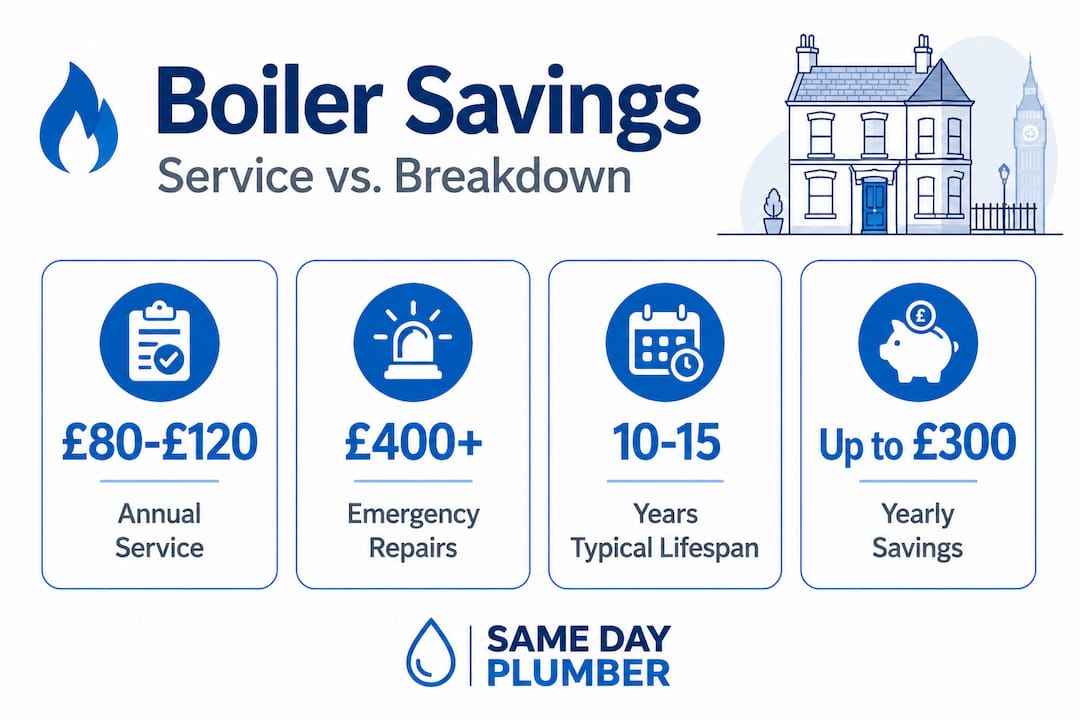
A standard annual boiler service costs between £80 and £120, depending on your location and the engineer you choose. An emergency callout for a boiler breakdown, by contrast, typically costs between £300 and £500 before parts are even factored in. In some cases, particularly for complex faults or older boiler models where parts are scarce, the total bill can reach well over £1,000. That is not an exaggerated figure. It reflects the real-world cost of reactive rather than preventative maintenance.
| Scenario | Typical cost | Frequency |
|---|---|---|
| Annual boiler service | £80 to £120 | Once per year |
| Emergency breakdown repair | £300 to £500+ | Unpredictable |
| Boiler replacement (premature failure) | £2,000 to £4,500 | Every 8 to 10 years without service |
| Extra energy bills from inefficiency | £100 to £300 per year | Ongoing |
The energy saving angle is particularly compelling. A boiler that has dropped even 10% in efficiency will cost you an additional £100 to £150 per year in gas bills. If it has been neglected for three or four years, that figure compounds significantly. Regular servicing can reduce energy bills by £100 to £300 annually, which means it often pays for itself entirely within the year.
Key financial benefits of annual servicing include:
- Prevention of small faults becoming major, expensive repairs
- Maintaining peak efficiency so your boiler uses less gas
- Avoiding the premium costs of emergency or out-of-hours callouts
- Protecting your boiler warranty, which is often voided without service records
- Keeping your home insured for boiler-related damage claims
Pro Tip: Many boiler manufacturers and home insurance providers require documented proof of annual servicing before they will honour a warranty or insurance claim. Keep every service record you receive, even if it is just a simple receipt or engineer's report.
When you factor in boiler repair costs against the modest annual service fee, it becomes clear that servicing is not an optional luxury. It is straightforward financial sense. Consider also that heating repairs carried out during a service, when a fault is caught early, are almost always far cheaper than the same repair made under emergency conditions on a cold January evening.
Legal, warranty and insurance reasons you can't ignore
Many homeowners assume that boiler servicing is purely about function or utility bills. In reality, skipping a service can have serious legal and financial consequences that many people only discover when it is far too late.
For landlords, the situation is legally clear. Here is a straightforward breakdown of the key obligations and implications:
- Landlords must arrange annual boiler servicing under the Gas Safety (Installation and Use) Regulations 1998. This is a legal requirement, not a recommendation.
- A Gas Safety Certificate (CP12) must be issued annually by a Gas Safe registered engineer and provided to tenants within 28 days of inspection.
- Failure to comply can result in fines or even criminal prosecution in serious cases.
- For owner-occupiers, servicing is not a legal obligation in the same way, but it is required to keep most boiler warranties valid.
- Home insurance policies frequently include clauses requiring evidence that appliances, including boilers, have been maintained professionally.
It is worth understanding a critical distinction that many homeowners confuse: the difference between a safety check and a full service is substantial. A Gas Safety Check confirms that the boiler was safe at the time of the inspection. It does not clean internal components, test performance over time, or check for wear that is not yet causing an immediate hazard. A full service does all of those things.
This is a particularly important distinction for landlords. Having only a Gas Safety Certificate does not satisfy the requirement for regular maintenance that most boiler warranties and comprehensive home insurance policies demand. If you are a landlord who has only been booking the annual safety check and skipping the full service, you may be exposed to claims being denied.
According to official guidance, landlords must legally service boilers annually, and homeowners who want their warranties and insurance to remain valid need to do the same.
A small but important note: if you are unsure whether your current boiler maintenance meets compliance requirements, booking boiler repairs for safety compliance with a Gas Safe qualified engineer is the safest way to get clarity and put things right.
Best practices: Timing and choosing the right engineer
So if you know you need a service, here is how to get it done properly and avoid the common pitfalls that can leave you paying more or, worse, ending up with unreliable work.
When to book your service
Timing matters more than most people realise. The majority of UK homeowners book boiler services in autumn or winter, which is exactly the wrong time to do so. Demand for Gas Safe engineers peaks between October and February, meaning:
- Availability is reduced, often by several weeks.
- Waiting times can stretch when you need help urgently.
- Some engineers charge more during peak demand periods.
- If a fault is found, parts and follow-up repairs also take longer in busy periods.
Scheduling your service in summer or early autumn is genuinely better practice. Engineers are more available, prices are occasionally more competitive, and you have time to arrange any necessary repairs before the cold weather arrives. Booking in June, July, or August is ideal. Your boiler is also easier to test thoroughly when it has had a summer of light or no use.
How to choose a qualified engineer
This is where many homeowners go wrong. Choosing the cheapest quote on a social media group or a leaflet through the door can be a serious mistake. Always verify the following before agreeing to any work:
- Gas Safe registration: Check the engineer's ID card and verify their registration on the official Gas Safe Register at gassaferegister.co.uk.
- Experience with your boiler brand: Some engineers specialise in specific manufacturers. Ask directly.
- Evidence of insurance: Public liability insurance protects you if something goes wrong.
- Written confirmation of work: Always get a detailed service report, not just a verbal reassurance.
- Clear pricing upfront: Reputable engineers provide a fixed or clearly estimated fee before starting.
Pro Tip: If you are searching for a local boiler repair professional, always ask to see their Gas Safe card before any work begins. Legitimate engineers carry it with them and will show it willingly. Anyone who hesitates or makes excuses is a red flag.
A thorough engineer will also take the time to explain what they found, what they did, and what, if anything, needs attention. A service completed in under 20 minutes with no written report is almost certainly not a full service, regardless of what you were charged.
Why waiting for breakdowns is a costly mistake
We have worked with homeowners across the UK who all share a remarkably similar story. Everything seemed fine. The boiler was running. The radiators were warm. Why spend money on a service when there's no obvious problem? Then January arrives, the temperature drops to freezing, and the boiler stops working entirely.
The uncomfortable truth is that most significant boiler faults do not announce themselves with obvious warning signs. They develop quietly over months, sometimes years, invisible to the untrained eye. A cracked heat exchanger. A pressure relief valve on the verge of failure. A build-up of scale around the burner. These are not problems you will notice from your living room. They are exactly the kind of issues a service is designed to catch before they become a crisis.
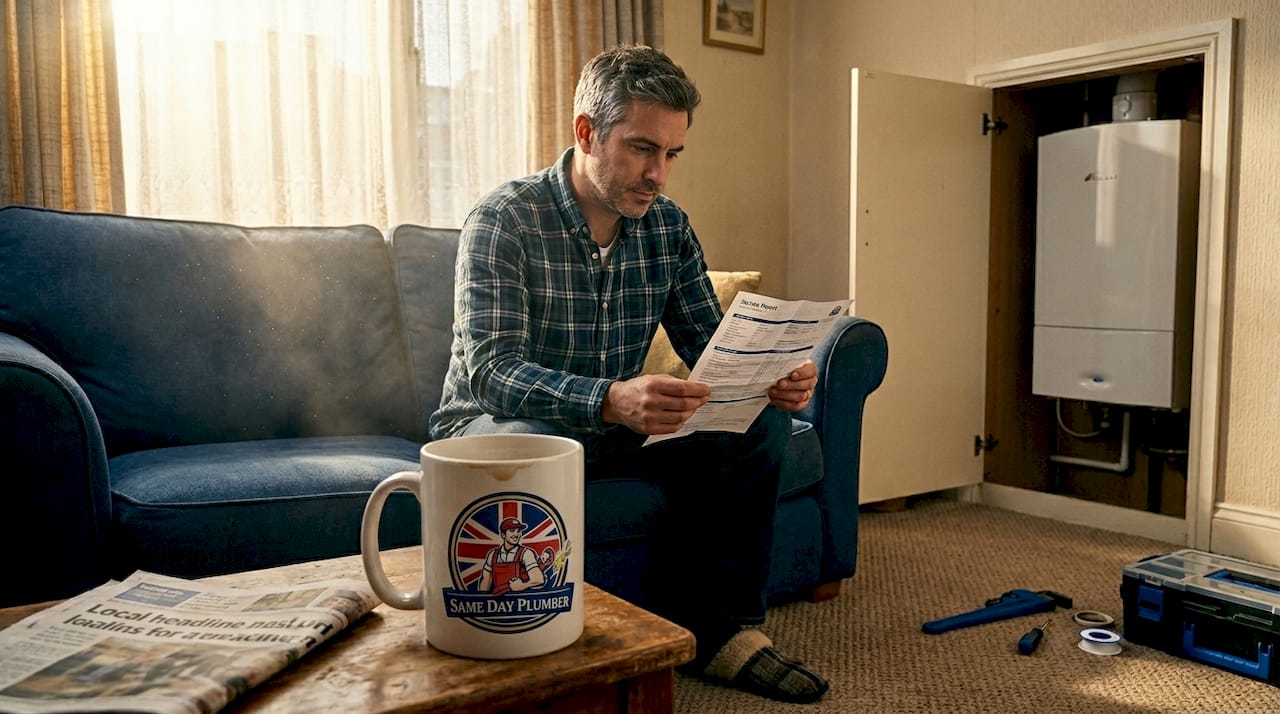
From our experience, the homeowners who end up in the most difficult financial situations are rarely those who had catastrophically bad luck. They are those who deferred servicing for two, three, or four years, assuming that no news was good news. When the fault finally forced itself into the open, the real-world repair costs were always far higher than a few years of servicing would have cost combined.
There is also the matter of insurance and warranty claims. We see this regularly. A homeowner has a boiler failure, submits a claim, and is then asked to provide service records. When those records do not exist, the insurer declines the claim entirely. The homeowner pays out of pocket for what could easily be a £1,500 repair or a full boiler replacement. That outcome is entirely avoidable.
Peace of mind is consistently undervalued until the moment it disappears. Knowing your boiler has been checked, cleaned, and certified as safe is worth something real. Especially on a cold night, especially if you have children or elderly relatives at home, and especially if you are renting a property out to tenants who are depending on you to keep them safe.
Servicing is not the flashiest home maintenance task. It will never feel as satisfying as a new kitchen or a fresh coat of paint. But it is quietly one of the most important things you can do for your home, your family, and your finances.
Need a trusted local engineer? Fast help is a click away
If you have been putting off your boiler service or want peace of mind before the colder months arrive, the best time to act is now. A small investment in routine maintenance today protects you from far larger costs and stresses down the line.

At Same Day Plumber, we offer same day boiler servicing with no call-out charge and a no fix, no fee guarantee. Our Gas Safe registered engineers are available 24 hours a day, 7 days a week, covering both planned maintenance and emergency callouts. Whether you need a routine annual service or urgent help with a breakdown, we are ready to respond quickly and get things sorted properly the first time. You can also reach us as an emergency plumber in Reading if you need immediate assistance. Do not wait until the cold sets in.
Frequently asked questions
How often should boilers be serviced in the UK?
Annual servicing by a Gas Safe registered engineer is the standard recommendation from UK energy experts and is required by most boiler manufacturers to keep warranties valid.
What does a boiler service include?
A service covers safety inspections, combustion performance testing, cleaning of key components, and checking that the boiler operates efficiently and reliably, going well beyond a basic safety check.
Can I service my own boiler?
No. Gas Safe engineers only are legally permitted to service gas boilers in the UK. Attempting it yourself is both dangerous and likely to void any warranty or insurance cover you have.
Does regular servicing really save money?
Yes. Servicing reduces energy bills by up to £300 per year by keeping your boiler running at peak efficiency, and it prevents costly emergency repairs and premature replacements.
What is the difference between a gas safety check and a boiler service?
A gas safety check confirms safety only at the point of inspection, while a full boiler service includes cleaning, testing internal components, and identifying wear that could cause problems in future.