
Choosing the cheapest plumber available might feel like a win in the moment, but it rarely works out that way. Poor workmanship hides behind walls, under floors, and inside fittings until a seemingly small fault becomes a very expensive emergency. In fact, emergency repairs cost three to five times more than planned quality work, which means skimping upfront can cost you far more down the line. This article will walk you through the real financial and structural risks of poor plumbing, show you what quality actually looks like, and give you the tools to make smarter choices for your home.
Table of Contents
- The hidden costs of poor plumbing
- What defines 'quality' plumbing?
- Short-term savings vs. long-term value
- How to choose a reliable plumbing professional
- The uncomfortable truth: cutting corners rarely pays
- Choose quality, safeguard your home
- Frequently asked questions
Key Takeaways
| Point | Details |
|---|---|
| Cheap work costs more | Cutting corners on plumbing often leads to emergency repairs costing several times more than original savings. |
| Quality protects value | Proper plumbing safeguards your property and helps sustain or grow its market value. |
| Choose proven professionals | Investing in experienced, well-reviewed plumbers minimises long-term risk and disruption. |
| Look for industry standards | Key quality markers include pressure testing, correct pipe slope, and thorough venting. |
The hidden costs of poor plumbing
It's easy to focus on the upfront bill when hiring a plumber. But the true cost of poor plumbing only reveals itself over time, and it is rarely pleasant when it does.
Substandard installations and rushed repairs create a cascade of problems that compound quickly. Here are some of the most common hidden expenses that homeowners face after choosing cut-price plumbing:
- Water damage to walls, floors, and ceilings from slow leaks that go undetected for weeks or months
- Rising water bills caused by hidden drips or poorly fitted joints that waste water constantly
- Structural damage where persistent damp rots timber joists and undermines the integrity of floors or walls
- Mould growth resulting from moisture accumulation behind surfaces, which can pose real health risks to your household
- Appliance failure when incorrectly installed pipes or fittings damage boilers, washing machines, or dishwashers over time
- Blocked drainage from pipes laid at the wrong gradient, causing recurring clogs and unpleasant odours
Each of these problems carries its own repair cost, but more often than not they arrive together. A slow leak feeds mould, which damages timber, which requires a full strip-out and rebuild. What started as a cheap install can quickly spiral into a five-figure restoration project.
"Saving £100 on a plumbing job today could realistically cost you £1,000 or more in related repairs within the next two years." This is not scaremongering; it reflects a straightforward pattern we see repeatedly in domestic plumbing.
The relative costs of poor plumbing research makes it clear: unplanned emergency repairs consistently cost three to five times more than the equivalent planned, quality installation. That statistic alone should reframe how you think about plumbing as a household expense.
Proper installation standards exist for a reason. When pipes are fitted correctly, joints are sealed properly, and water pressure is balanced throughout your system, everything runs as it should. When those standards are ignored, your home becomes a ticking clock. Understanding the full spectrum of common plumbing problems can help you recognise the early warning signs before they escalate.
What defines 'quality' plumbing?
Quality plumbing is not just about a job that looks neat. It is about a job that performs reliably for years, meets professional standards, and protects your home from avoidable damage.
Here is a clear breakdown of what separates high-quality plumbing from rushed or substandard work:
| Quality indicator | What it means | Why it matters |
|---|---|---|
| Pressure testing | Joints are tested under pressure before completion | Catches hidden leaks before walls are closed up |
| Correct pipe slope | Drain pipes run at 1/4 inch per foot gradient | Ensures waste flows freely and does not pool |
| Proper venting | Soil stacks and traps are correctly vented | Prevents gurgling drains and sewer gas entry |
| Certified materials | Fittings and pipes meet British Standards | Reduces risk of early failure or corrosion |
| Finished insulation | Exposed pipes are lagged against cold | Protects against burst pipes in winter |
| Documented work | Plumber provides certificates and paperwork | Essential for warranty claims and property sales |
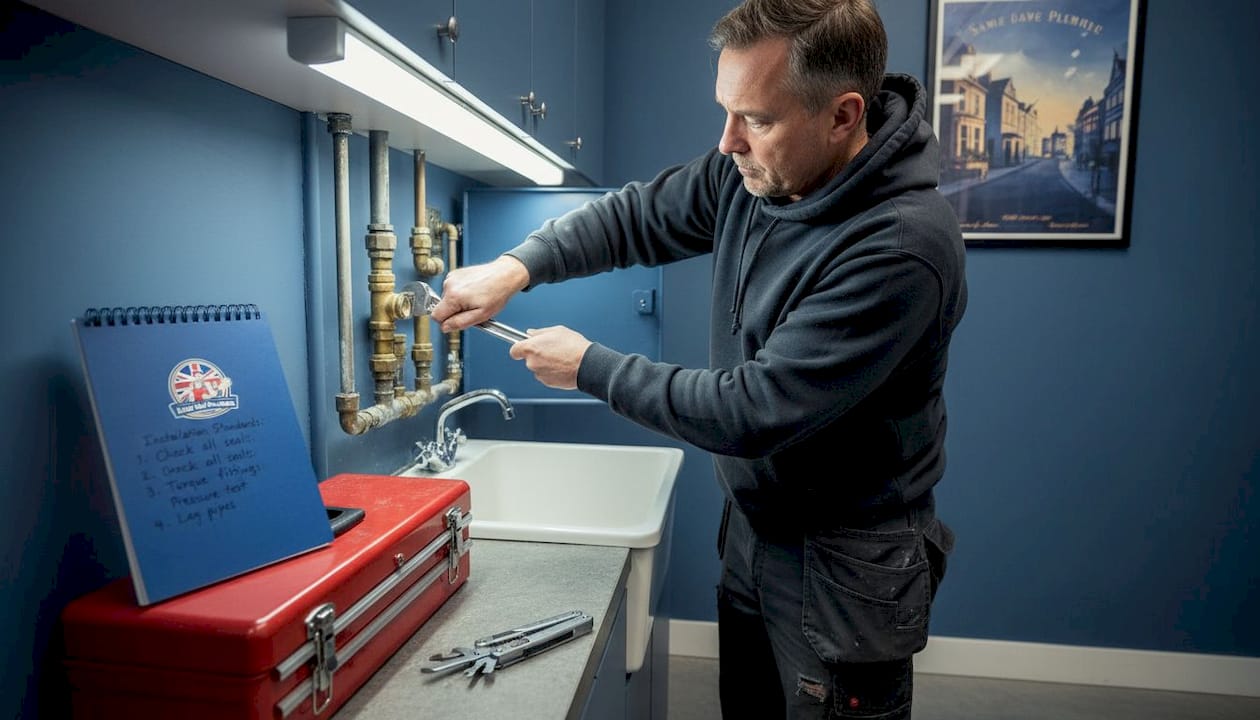
According to proper installation standards, quality work includes pressure-testing all joints, maintaining a correct pipe slope of 1/4 inch per foot, and ensuring adequate venting to prevent gurgling and trap seal loss. These are not optional extras. They are fundamental requirements for a plumbing system that does its job without causing problems.
When corners are cut on any of these points, the consequences are predictable. Poorly vented drains gurgle and emit foul smells. Incorrectly sloped pipes block repeatedly. Untested joints fail behind plasterboard, causing water damage that may not be discovered for months.
Pro Tip: Before a plumber closes up any wall or floor, ask them to confirm whether a pressure test has been carried out. A reputable professional will do this as standard and will not object to telling you.
Certifications and qualifications also matter enormously. In the UK, plumbers working on gas appliances must be Gas Safe registered. For broader plumbing work, membership of recognised trade bodies such as the Chartered Institute of Plumbing and Heating Engineering (CIPHE) or the Association of Plumbing and Heating Contractors (APHC) signals a commitment to professional standards.
When selecting trustworthy plumbers, always ask to see proof of qualifications before any work begins. A skilled professional will be proud to show you their credentials.
Short-term savings vs. long-term value
The appeal of a cheaper quote is understandable. Household budgets are tight, and plumbing costs can feel like an unwelcome surprise. But when you look at the full picture over five or ten years, the numbers tell a very different story.
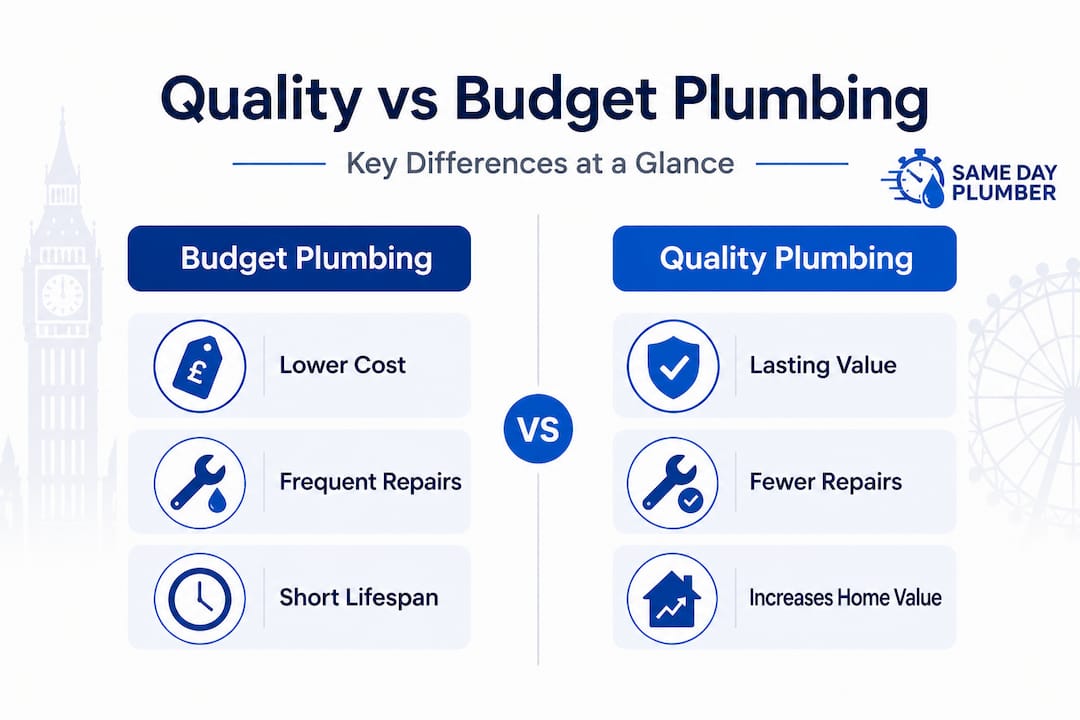
| Factor | Budget plumbing | Quality plumbing |
|---|---|---|
| Upfront cost | Lower | Moderate to higher |
| Repair frequency | High (often within 1-2 years) | Low (5+ years typical) |
| Emergency call-out risk | Significantly higher | Significantly lower |
| Water bill impact | Often increased from hidden leaks | Efficient and stable |
| Impact on home value | Can reduce value or complicate sales | Maintains or increases value |
| Peace of mind | Low | High |
The financial argument for quality plumbing becomes even more compelling when you factor in the property market. Buyers and their surveyors look closely at a home's plumbing condition. Evidence of poor workmanship, water damage, or repeated patch repairs raises red flags that can reduce your property's value or cause a sale to fall through entirely.
As we have already noted, unplanned repairs cost three to five times more than planned quality work. That multiplier effect, when applied to a series of small failures over several years, can far exceed what you would have paid for a quality installation at the outset.
Understanding why fast response matters in plumbing emergencies is also relevant here. When poor workmanship causes a sudden failure, the speed with which you can get it addressed directly affects how much secondary damage occurs. Every hour of delay is an hour of water spreading further.
If you are buying or selling a property, follow these steps to appraise the plumbing:
- Request the boiler service history and check for any recurring issues
- Inspect visible pipework under sinks and around appliances for signs of corrosion, leaks, or amateur repairs
- Run taps and flush toilets to check water pressure and drain flow
- Ask about any plumbing works carried out and request certificates or guarantees where applicable
- Commission a full plumbing survey if you have any doubts, particularly in older properties
These steps can save you thousands by revealing problems before you commit to a purchase, or by helping you present your own property in the best possible light.
How to choose a reliable plumbing professional
Knowing the risks and understanding what quality looks like is only half the battle. The other half is finding the right person to do the work.
Here is what to look for when choosing a plumber:
- Gas Safe registration if any gas appliances are involved
- Membership of a recognised trade body such as APHC or CIPHE
- A clear, itemised written quote before work begins
- Positive, verifiable reviews on independent platforms
- Willingness to provide references from previous clients
- Evidence of insurance including public liability cover
- A guarantee on labour as well as materials
Do not be swayed by speed alone. A plumber who arrives immediately and finishes quickly is not necessarily delivering quality work. Proper plumbing takes the time it takes. Pressure testing, correct pipe alignment, and thorough finishing cannot be rushed without compromising the result.
Quality installation standards require attention to detail at every stage, from the initial pipe layout to the final pressure check. A plumber who skips these steps to save time is not doing you a favour.
Pro Tip: Ask your plumber directly: "Will you pressure test the joints before closing up?" and "What guarantee do you offer on your labour?" The way they respond tells you a great deal about their professionalism.
When you need emergency plumbing services, speed does matter, but it should never come at the expense of doing the job correctly. The best emergency plumbers combine rapid response with proper workmanship. They fix the immediate problem without creating a new one.
Always get a quote in writing, even in an emergency situation. Reputable plumbers will always be transparent about costs and scope of work before they begin.
The uncomfortable truth: cutting corners rarely pays
We have seen the pattern more times than we can count. A homeowner books the cheapest plumber they can find, the work gets done, and for a few months everything seems fine. Then a small damp patch appears. Then a ceiling starts to bow. Then the insurance assessor delivers news that makes the original "saving" feel like a very expensive mistake.
The quick-fix mindset is genuinely damaging to home value and to peace of mind. It creates a cycle where repeated small repairs nibble away at both your budget and your confidence in your own home. When you stop trusting your plumbing, it affects how you feel about the place where you live.
The lasting impacts of poor plumbing go beyond repair bills. There are the sleepless nights wondering whether a dripping sound is something serious. There is the embarrassment of recurring issues when you have guests. There is the anxiety of knowing a problem is lurking somewhere you cannot see.
What we find particularly frustrating is that the regret is almost always the same. Homeowners tell us they wish they had checked qualifications and asked more questions before the original work was done. They assumed a plumber was a plumber and that any qualified-looking professional would do the job properly. That assumption, unfortunately, is not always warranted.
The research on repair costs reinforces what experience already tells us. Emergency repairs cost three to five times more than planned, quality work. But beyond the money, there is the disruption, the stress, and the lasting effect on your property.
Investing in quality plumbing is not a luxury. It is a practical, financially sound decision that protects your home, your household, and your peace of mind for years to come.
Choose quality, safeguard your home
If this article has made one thing clear, it is that quality plumbing is not an expense to minimise. It is an investment worth making properly from the start.
At Same Day Plumber, we combine rapid response with genuine craftsmanship because we know that speed without quality is not good enough. Whether you need planned work or an urgent fix, our team is available 24/7 with no call-out charge and a no fix, no fee promise. Explore our full range of plumbing services in Reading and see how we approach every job with the care it deserves. For urgent issues, our emergency plumbing solutions are ready when you need them most. And if you need same day plumbing support, we are here to help you get it sorted properly, first time.
Frequently asked questions
How quickly can poor plumbing cause damage?
Even minor faults such as a slow-dripping joint or a poorly sealed connection can lead to significant water damage within days, and the cost of emergency repairs from such faults is consistently three to five times higher than planned quality work would have been.
What are the most important signs a plumber is delivering quality work?
Look for proper pressure testing of all joints, correct pipe slope for drainage, and thorough venting; proper installation practice includes all three as standard, and any plumber worth hiring will carry them out without needing to be asked.
Does quality plumbing increase my property value?
Yes, quality plumbing reduces future repair risk and gives buyers confidence, helping your property maintain or increase its value and making surveyors' reports far less likely to flag concerns.
Is emergency plumbing always more expensive?
Emergency repairs typically cost three to five times more than equivalent planned work, which is why investing in quality upfront is almost always the more economical choice over the long term.
Which questions should I ask before hiring a plumber?
Request evidence of qualifications and trade body membership, ask what guarantee they offer on their labour, confirm whether they will pressure test all joints, and find out whether their quote covers all materials and potential complications before any work begins.