
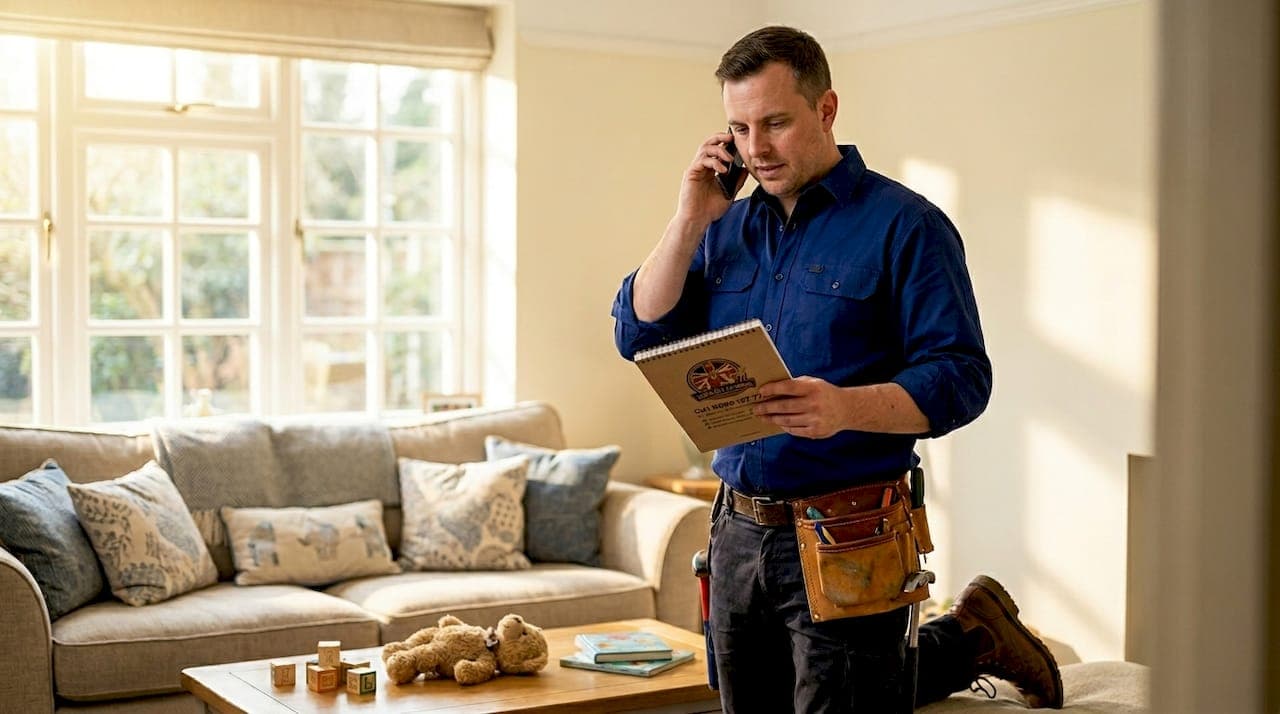
When a pipe bursts at midnight or sewage backs up into your kitchen, the last thing you need is confusion about how long help will take to arrive. Many homeowners assume that calling a plumber means someone shows up within minutes, only to find themselves waiting far longer than expected. The truth is that plumbing response times vary enormously depending on the nature of your problem, the time you call, and the firm you contact. This guide breaks down exactly what response time means, what genuinely counts as an emergency, and what you can do right now to get a plumber to your door as quickly as possible.
Table of Contents
- What does plumbing response time actually mean?
- How do plumbers decide what is urgent?
- Average response times and what influences them
- How to prepare for a plumbing emergency
- A professional's perspective: why one size never fits all in emergency plumbing
- Need urgent plumbing help? Local professionals are ready
- Frequently asked questions
Key Takeaways
| Point | Details |
|---|---|
| Know the definition | Plumbing response time is measured from your emergency call to the technician's arrival. |
| Urgency changes everything | Severe risks like flooding or sewage issues get fastest response, while minor leaks may wait. |
| Prepare before emergencies | Keep emergency contacts ready and know what details to share for priority dispatch. |
| No universal guarantees | Even the best plumbers face unpredictable delays—rely on professionalism and proactive communication. |
What does plumbing response time actually mean?
Before you can set realistic expectations, it helps to understand precisely what "response time" refers to in the plumbing industry. Response time measures the duration from the moment you report your urgent issue to the moment a technician actually arrives at your property. This is not the same as how long the repair takes, nor does it include any back-and-forth you have with a call handler. It is purely the gap between your call and the plumber standing at your front door.
This distinction matters enormously. A company might answer your call in 30 seconds, but if their nearest available technician is 90 minutes away, your response time is 90 minutes. Understanding this helps you ask the right question: not "do you answer calls quickly?" but "how long until someone arrives?"
To understand more about what classifies as a genuine plumbing crisis, it is worth reading emergency plumbing explained in detail. Some situations are unambiguously urgent. Others feel urgent but can safely wait a few hours.
Response time is the clock that starts ticking from your call and stops the moment the plumber knocks on your door. Everything in between is what you need to plan for.
Here are the situations that most plumbing firms classify as live emergencies requiring the fastest possible response:
- Burst or fractured pipes with active water escaping
- Sewage backup into your home
- A heavily leaking hot water cylinder or boiler
- Flooding from a leaking ceiling or internal pipe failure
- Complete loss of water to the property caused by a suspected failure
- Any situation where water is in contact with electrical fittings
These scenarios can cause structural damage, health hazards, and significant financial loss in a very short time. That urgency directly shapes how quickly any reputable firm will respond.
How do plumbers decide what is urgent?
Not every call that arrives at a plumbing dispatch centre is treated equally. Professional plumbers triage (sort by severity) incoming calls to decide which jobs need immediate attention and which can be booked for later. This process is standard practice across the industry, and it directly affects how quickly you see a plumber.
When you call, a dispatcher will ask a structured set of questions to assess the risk level of your situation. Active flooding, sewage contamination, and electrical risk are the factors that push a call to the top of the list. A slow drip from a tap or a toilet that runs a little long after flushing would not receive the same urgency.
Here is a typical sequence a dispatcher follows when triaging your call:
- Identify the source. Is water actively escaping, or is the issue contained?
- Assess the volume. Is it a trickle or a significant flow? Is there pooling or flooding?
- Check for contamination. Is there any sewage or grey water involved?
- Look for safety hazards. Is electricity nearby? Is there a risk of structural damage?
- Confirm the address and access. Can a technician get to you quickly? Is anyone home?
Pro Tip: Before you call, take 60 seconds to watch where the water is coming from, whether it is getting worse, and whether there are any electrical sockets or fittings nearby. This information will help dispatch classify your call as high priority far more quickly.
The table below compares how different types of plumbing issues tend to be classified and the typical response priority they receive:
| Issue type | Risk level | Typical priority |
|---|---|---|
| Burst pipe with active flooding | Critical | Immediate |
| Sewage backup into living areas | Critical | Immediate |
| Leaking ceiling from above | High | Same hour |
| Hot water cylinder heavily leaking | High | Same hour |
| Low-pressure trickle leak | Medium | Same day |
| Running toilet | Low | Scheduled |
| Dripping tap | Low | Scheduled |
Response policies differ from one provider to another. Smaller, local firms often have greater flexibility to reach you quickly. Larger national chains may have more resources but also higher call volumes. The key is finding a firm that handles professional plumbing for urgent repairs and is transparent about how they prioritise calls. You should also familiarise yourself with what a 24 hour plumber guide covers so you know what to demand from a round-the-clock service.
Average response times and what influences them
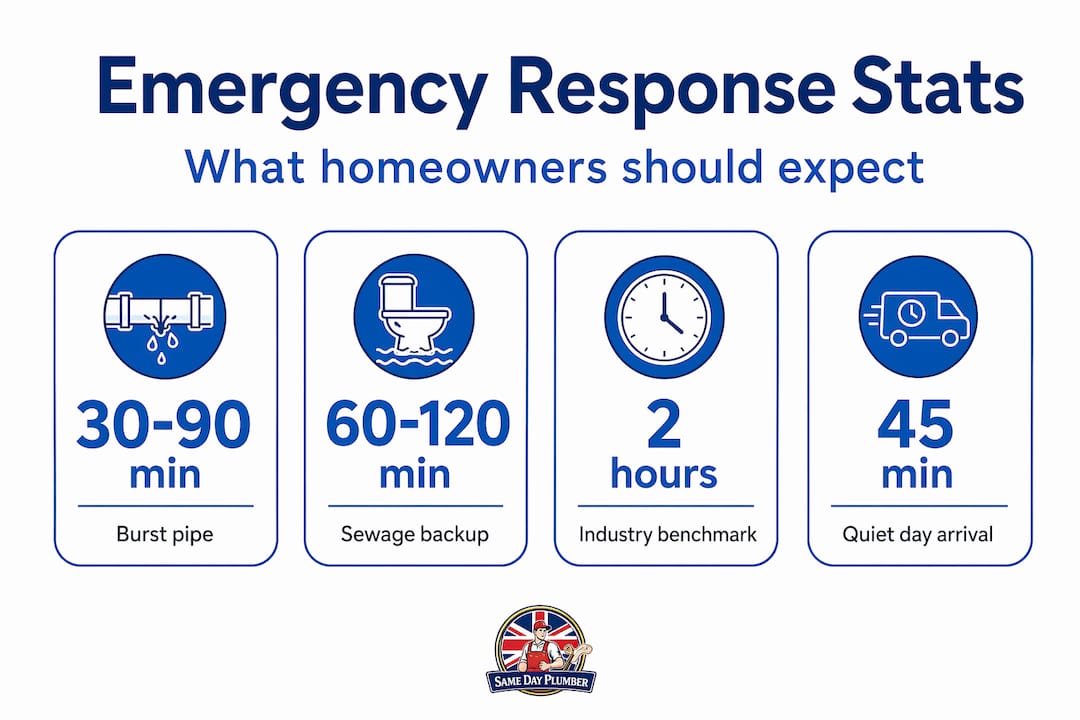
So what numbers should you actually expect? For live emergencies such as burst pipes, active flooding, or sewage backup, most professional emergency plumbing firms aim to arrive within one to two hours. Some well-staffed local firms can manage under an hour. For less severe urgent issues, same-day service is the standard target.
Response time varies based on distance from call to arrival and a range of factors entirely outside your control. Understanding those factors helps you set realistic expectations and make smarter decisions when choosing who to call.
Here is a breakdown of the most common factors that influence how quickly a plumber reaches you:
- Time of day. Peak hours mean more jobs in the queue. Late evenings and early mornings may have fewer available technicians depending on the firm.
- Local demand. A heavy rainstorm or cold snap can trigger dozens of burst pipe calls simultaneously, stretching every firm's resource.
- Traffic and distance. Urban areas may have more plumbers nearby, but rush hour traffic can offset that advantage entirely.
- Technician availability. If every available plumber is already mid-job, there is a genuine queue regardless of how urgently you need help.
- Weather conditions. In winter, icy roads affect travel times. In extreme weather events, demand spikes sharply.
- Size of the firm. A well-staffed local company covering your area specifically can often beat a national chain simply because their team is already nearby.
The table below gives a practical overview of realistic timeframes based on typical emergency scenarios:
| Scenario | Expected response time |
|---|---|
| Burst pipe, live flooding | 30 to 90 minutes |
| Sewage backup | 60 to 120 minutes |
| Heavy ceiling leak | 60 to 120 minutes |
| Urgent but non-flooding leak | 2 to 4 hours |
| Same-day non-emergency | Within the working day |
Key number to remember: For a genuine live emergency, the industry benchmark is arrival within two hours. If you are being quoted significantly longer during a critical situation, consider calling additional firms while you wait.
Understanding the importance of fast plumbing service goes beyond convenience. Water damage escalates quickly. Within 30 minutes, water can soak through flooring and into subfloor structures. Within a few hours, walls and ceilings absorb enough moisture to require extensive drying work. The financial and structural stakes make response time a genuinely critical issue, not just a comfort factor.
How to prepare for a plumbing emergency
Knowing what influences response times is useful, but what can you actually do about it in the middle of a crisis? The steps you take in the first five minutes of a plumbing emergency have a direct impact on both the speed of response and the extent of the damage. Being prepared before anything goes wrong makes those first minutes far less chaotic.
Here are the immediate steps to take the moment you suspect a plumbing emergency:
- Turn off your water supply. Locate your stopcock (usually under the kitchen sink or near the water meter) and turn it off immediately to stop further water escaping.
- Turn off electricity in affected areas. If water is near any sockets, switches, or appliances, switch off the power at your fuse box for those circuits.
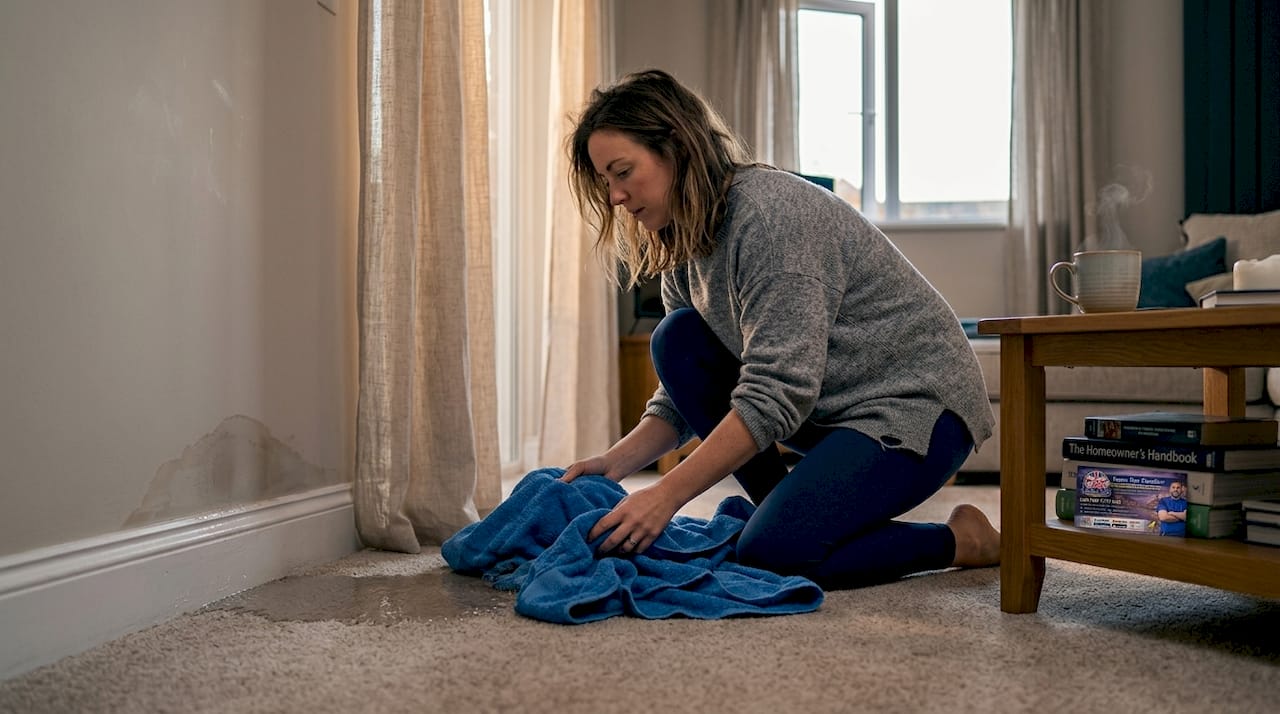
- Contain the water. Use towels, buckets, and bowls to collect water and reduce spread onto flooring and walls.
- Photograph the scene. A quick set of photos before you clean up supports insurance claims later.
- Call a plumber with clear information ready. Do not wait until you have contained the situation. Call immediately and stay on the move.
When you do call, the quality of the information you provide shapes how quickly a plumber is dispatched. Accurate emergency reporting ensures the call handler can classify your situation correctly and send the right person with the right equipment. Vague descriptions like "there's a problem with my pipes" slow everything down.
Pro Tip: Keep a short note near your stopcock with your full address, the location of your stopcock, and the number of your preferred emergency plumber. When water is pouring through your ceiling, you will not want to be searching your phone for details.
Here are the things to avoid doing that commonly delay plumber response:
- Calling multiple firms simultaneously without telling each one, creating confusion and duplicate bookings
- Failing to mention the severity of flooding or safety risks, causing the call to be classified as low priority
- Giving an incomplete address or not staying available by phone for follow-up questions from dispatch
- Attempting DIY fixes that make it harder for the plumber to assess the original fault quickly
You can find a full breakdown of the key services and preventative measures worth knowing about in this guide to essential plumbing services for UK homeowners.
A professional's perspective: why one size never fits all in emergency plumbing
We want to be honest with you about something the broader industry does not always say out loud: no plumbing firm, however well-staffed and well-run, can guarantee identical response times in every situation. Anyone who promises you a fixed arrival window regardless of circumstances is either very lucky or not being fully transparent.
Here is the reality we work within. On a quiet Tuesday morning, we can often reach a customer within 45 minutes. On a freezing January night, when a cold snap has caused burst pipes across an entire postcode, that same journey might take twice as long simply because every available technician is already managing a critical job. That is not a failure of professionalism. That is the reality of serving multiple households in genuine distress at the same moment.
What distinguishes a quality firm is not a promise of a specific minute count. It is robust protocols: clear triage, honest communication about expected times, regular updates while you wait, and technicians who arrive equipped to handle the most common emergencies without a second trip. It is also transparency. We would rather tell you "we are 75 minutes away" than say "30 minutes" and arrive late.
We have also seen homeowners hurt their own response times by not acting to protect their home in the minutes before help arrives. Turning off the water at the stopcock, isolating electrics, and calling clearly with accurate information all make a tangible difference to the outcome, not just to how quickly we can reach you.
The right expectation is this: a reliable, well-resourced emergency plumber should aim for arrival within two hours for a live emergency, keep you informed throughout, carry the tools to handle common problems immediately, and be honest when external factors are causing delays. That is what genuine professionalism looks like, and it is the standard you should hold any firm to when the worst happens.
Need urgent plumbing help? Local professionals are ready
If you are reading this in the middle of a plumbing crisis, you need fast, reliable help from professionals who take emergencies seriously. Same Day Plumber operates with no call-out charge, a no fix no fee policy, and full 24/7 availability because we know plumbing disasters do not keep business hours.

Whether you need an emergency plumber in Reading or broader same day plumbing across the area, we are ready to respond. Our local technicians are dispatched quickly and arrive equipped to handle the most common emergency situations on the first visit. You can reach our same day emergency plumber service right now, any hour of the day or night, and speak directly with someone who will take your situation seriously from the very first call.
Frequently asked questions
How fast can I expect a plumber in a genuine emergency?
In critical situations such as active flooding or sewage backup, response times are often within one to two hours, and sometimes less if a local technician is already nearby and available.
What types of plumbing problems are not considered emergencies?
Non-emergencies typically include slow leaks, minor drips, or issues without active water escape or safety risk and these are usually scheduled rather than dispatched immediately.
Can I get guaranteed response times when I call a plumber?
No reputable plumbing company will promise a guaranteed arrival time, as local conditions, traffic, and emergency call volumes can always cause genuine delays regardless of best intentions.
How can I help speed up the plumber's arrival?
Describe your emergency clearly and accurately, give your exact address including any access notes, and stay available by phone so the dispatch team can reach you with updates or clarifying questions.