
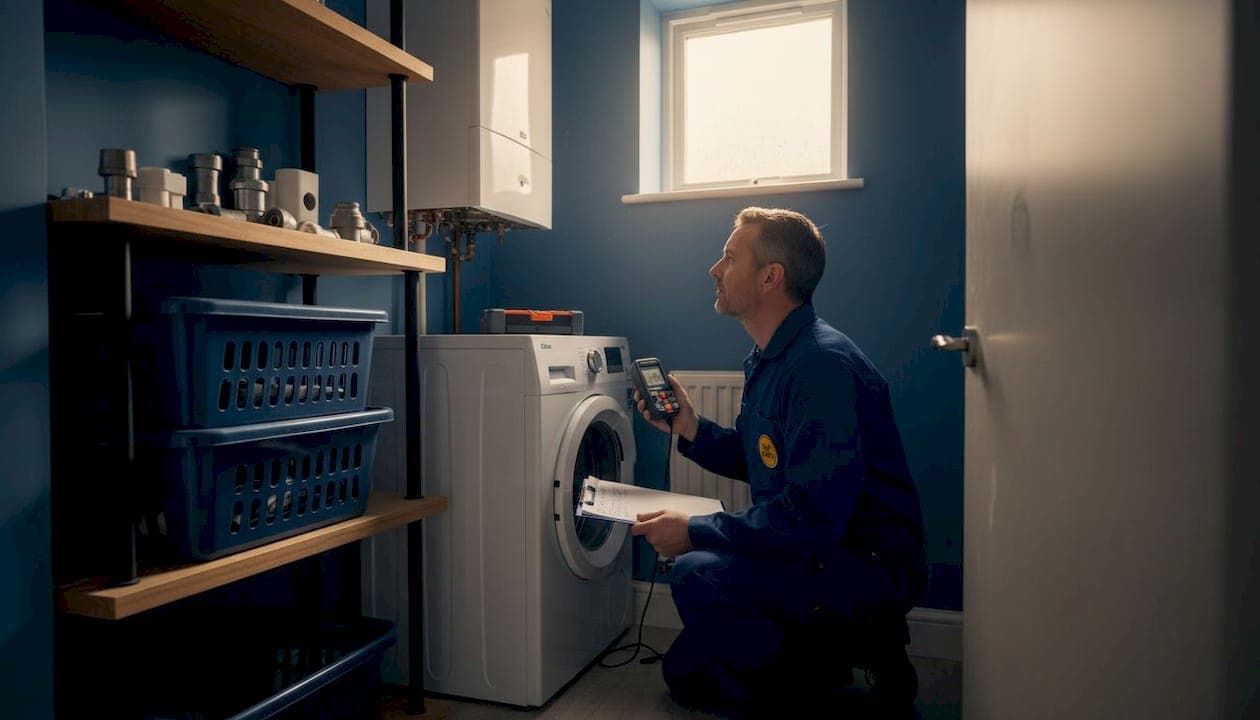
Most homeowners in Reading, Newbury, Basingstoke, and Bracknell only think about their boiler when something goes wrong. That's a costly habit. Annual boiler servicing helps engineers detect problems before they become costly repairs and also supports gas safety in the home. A boiler that fires up every morning and keeps your radiators warm can still harbour faults that build quietly over months, putting your family at risk and your energy bills on the rise. This article explains why yearly maintenance matters, what it actually involves, and how it protects both your safety and your wallet.
Table of Contents
- What is annual boiler maintenance and why is it recommended?
- How annual maintenance boosts efficiency and lowers costs
- Warranty requirements and legal obligations for homeowners
- Choosing the right engineer and what to expect during a service
- The truth most homeowners miss about annual servicing
- Book trusted boiler servicing for your local area
- Frequently asked questions
Key Takeaways
| Point | Details |
|---|---|
| Safety first | Annual checks guard against carbon monoxide and gas leaks, ensuring your family remains safe. |
| Save money | Routine maintenance helps prevent costly winter repairs and keeps boiler warranties valid. |
| Choose qualified engineers | Always hire Gas Safe-registered engineers to guarantee both legal compliance and effective servicing. |
| Prevent disruption | Regular checks dramatically lower the risk of heating breakdowns when you need warmth most. |
What is annual boiler maintenance and why is it recommended?
Annual boiler maintenance is a scheduled inspection carried out once a year by a qualified professional. It is not a repair visit, and it is not something reserved for older or temperamental boilers. Think of it like a MOT for your car: the vehicle might drive perfectly well, but the inspection still checks for faults you cannot see or feel.
During a standard service, a Gas Safe-registered engineer will typically carry out the following checks:
- Gas pressure and flow: Verifying the boiler receives the correct gas supply and burns it efficiently.
- Flue and combustion: Inspecting the flue for blockages or damage, and confirming combustion gases are venting safely outside.
- Leak detection: Checking pipework, seals, and the heat exchanger for any signs of water or gas leaks.
- Safety devices: Testing pressure relief valves, thermostats, and controls to ensure they respond correctly.
- Cleaning internal components: Removing soot, scale, and debris from burners and filters that accumulate over the year.
- Carbon monoxide risk assessment: Identifying any conditions that could lead to carbon monoxide production or leakage.
"A boiler service includes safety checks aimed at reducing risks such as carbon monoxide leaks, and includes flue and combustion-related verification."
Carbon monoxide is odourless and colourless. It kills silently, which is precisely why an annual check is so important. A boiler that appears to run normally can still produce dangerous levels of carbon monoxide if its burner or flue is even slightly compromised. The yearly service is your primary line of defence against this invisible threat.
One of the most persistent misconceptions is that servicing is only needed when a boiler starts making noise or displaying error codes. In reality, many serious faults develop without any visible warning sign at all. Following a proper boiler maintenance checklist each year ensures nothing is missed, regardless of how well the boiler appears to be performing.

Pro Tip: Book your annual service in late summer, before the autumn rush. Engineers are busier in October and November, and getting ahead means you have heating certainty before the cold really bites.
How annual maintenance boosts efficiency and lowers costs
Understanding what a service includes, let's look at how annual checks translate to real, measurable benefits for homeowners.
A boiler that has not been serviced for two or three years does not suddenly collapse. Instead, it gradually becomes less efficient. Scale builds on the heat exchanger, burners run slightly rich or lean, and small leaks in the system let in air that causes corrosion. Each problem, on its own, might seem trivial. Together, they push your energy bills up and shorten the boiler's working life.
Here is a straightforward comparison of what serviced and non-serviced boilers typically cost homeowners over time:
| Factor | Serviced boiler | Non-serviced boiler |
|---|---|---|
| Average annual service cost | £80 to £120 | £0 (short-term saving) |
| Typical energy efficiency | 88% to 95% | Can drop to 75% to 80% |
| Risk of emergency call-out | Low | Significantly higher |
| Average emergency repair cost | £150 to £400 (caught early) | £500 to £1,500+ (advanced fault) |
| Boiler lifespan | 15 years or more | Often 10 to 12 years |
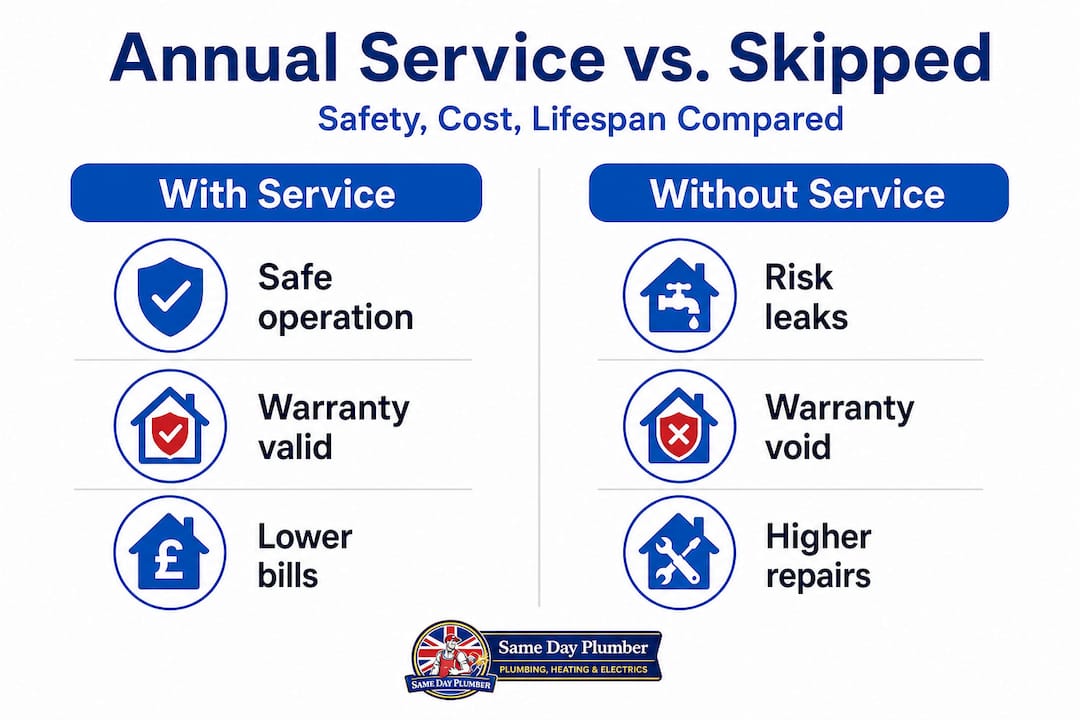
The figures above illustrate why skipping a service to save £100 can end up costing you several times that amount within just a few years. Servicing saves money in ways that are not always obvious until something breaks at the worst possible moment.
Did you know? A boiler running at 80% efficiency instead of 93% wastes roughly 13p of every £1 you spend on gas. On a typical annual gas bill of £900 in the south of England, that is around £117 thrown away each year, more than the cost of the service itself.
Fewer breakdowns and emergency repairs are another direct benefit of routine maintenance, and the timing matters enormously. Boiler failures spike in December and January when engineers are in high demand and waiting times stretch. A boiler that has been serviced in September is far less likely to leave your family without heating in the middle of winter.
Early issue detection is arguably the most valuable outcome. A preventing boiler breakdowns approach means an engineer might spot a failing pump seal or a corroding electrode during the service. Replacing a £25 seal in September is a very different experience from an emergency call-out on a Sunday night in January when the part needs ordering.
Pro Tip: Ask your engineer to show you any parts they clean or replace during the service. Seeing the build-up of scale or soot firsthand makes it easier to appreciate the value of the work being done.
Warranty requirements and legal obligations for homeowners
Annual maintenance is not just about saving money. It is also essential for protecting your investment and fulfilling your responsibilities as a homeowner.
Most modern boilers come with manufacturer warranties ranging from two to ten years, sometimes longer. What many homeowners in Basingstoke, Reading, and Bracknell do not read carefully is the fine print: warranty validity is strongly tied to annual servicing by a qualified engineer. Miss a single year and the manufacturer may refuse to cover a repair, even if the fault is entirely unrelated to maintenance.
Here is a side-by-side look at what you stand to lose:
| Scenario | With annual service | Without annual service |
|---|---|---|
| Manufacturer warranty | Valid, full cover | Potentially voided |
| Home insurance claim | Supported with service records | May be disputed or refused |
| Boiler repair responsibility | Manufacturer or warranty provider | Fully your cost |
| Resale value of property | Higher, with documented records | Lower, raises buyer concerns |
The legal position for landlords is stricter still. Under the Gas Safety (Installation and Use) Regulations 1998, landlords must arrange an annual gas safety check for every rental property. For homeowners, there is no equivalent legal obligation to service a boiler, but the insurance and warranty implications are serious enough to make it effectively necessary.
To stay fully protected, follow these four steps:
- Record every service. Keep the engineer's signed certificate somewhere safe, ideally both a physical copy and a digital photo.
- Choose a Gas Safe-registered engineer every time. This is the legal minimum standard for working on gas appliances in Great Britain.
- Book in the same calendar month each year. This creates a clear, consistent trail that satisfies most warranty terms without gaps.
- Know your boiler's warranty terms. Read the documentation or call the manufacturer to confirm exactly what the servicing requirements are.
If you are unsure what type of service your boiler actually needs, reviewing essential types of boiler repairs can help you understand the difference between a routine service and a repair, and spot signs your boiler needs repair that might warrant an earlier visit.
Choosing the right engineer and what to expect during a service
To fully benefit from annual maintenance, it is vital to choose the right professional. Not every engineer offering a cheap service delivers the same standard.
"An annual service is most meaningful when done by a competent, Gas Safe-registered engineer for gas boilers."
When you are looking to book, check the following before you confirm:
- Gas Safe Register number. Every engineer working on gas appliances must be registered. You can verify their registration on the Gas Safe Register website using their licence card number. Do not take their word for it.
- Relevant qualifications. Some engineers specialise in particular boiler brands. If your boiler is a Worcester Bosch or Vaillant, it is worth asking whether the engineer has specific experience with that manufacturer.
- Local reputation and reviews. Homeowners in Newbury and Reading often find that locally established engineers respond faster and are easier to contact if follow-up questions arise.
- Transparency about what is included. Ask directly what the service covers. If the engineer cannot clearly explain the checks they will perform, that is a warning sign.
Understanding the role of heating engineers helps you have a more informed conversation and ensures you are comparing like for like when getting quotes.
Here is what a typical annual service visit looks like, step by step:
- The engineer arrives and asks about any issues you have noticed since the last service.
- They inspect the boiler casing and look for obvious signs of damage, corrosion, or leaking.
- The flue is checked externally and, where accessible, internally for blockages or deterioration.
- The burner is removed, inspected, and cleaned if necessary.
- Gas pressure is tested at the boiler and compared against the manufacturer's specification.
- All safety controls, including the thermostat, pressure relief valve, and motorised valves, are tested.
- The engineer checks for carbon monoxide risks using specialist testing equipment.
- A service report is completed and signed, recording all findings.
- Any advisory notes about parts that may need attention in future are communicated clearly to you.
The whole visit typically takes between 45 minutes and one hour for a straightforward combi boiler. If you have a system boiler with a separate cylinder, allow a little longer. Following the visit, the boiler repair step by step process is much simpler if you already have a recent service record in place.
Pro Tip: When the engineer is working on your boiler, ask them to point out the pressure gauge and show you what a healthy reading looks like. This takes two minutes and means you can monitor it yourself between services.
The truth most homeowners miss about annual servicing
Moving beyond the technical details, let's consider the core principle that genuinely separates safe, efficient homes from ones that are quietly heading towards a problem.
The "if it's not broken, don't fix it" mindset is deeply human. It saves effort and avoids spending money that feels unnecessary in the moment. But boilers are one of the few domestic appliances where this logic is genuinely dangerous, not just inefficient.
Carbon monoxide does not announce itself. A cracked heat exchanger, a partially blocked flue, or a slightly misaligned burner can produce toxic gas while the boiler continues to run, fires every morning, and keeps the house warm. Your boiler displaying no faults is not the same as your boiler being safe.
The importance of servicing lies precisely in what it catches when everything seems fine. Experts frame annual servicing as a way to verify efficiency and safety going into winter even when the boiler appears to be working perfectly. That is not a commercial argument. It is a practical one grounded in how boiler faults actually develop.
We have seen the pattern repeatedly in homes across Reading, Newbury, and Basingstoke. A homeowner skips the service in autumn because the boiler ran fine all summer. By December, a fault that would have cost £80 to fix in September has developed into a full heat exchanger failure. The part alone costs over £400, the wait stretches to a week, and the family is living on electric heaters in January. The £100 saving in September cost them over £700 in December.
Shifting from a reactive to a preventative mindset does not require you to become an expert in boiler mechanics. It just requires booking one appointment per year with a qualified engineer. That single decision protects your warranty, reduces your energy costs, guards against carbon monoxide, and gives you the confidence that your heating will work when you need it most.
Book trusted boiler servicing for your local area
If reading this has prompted you to check when your boiler was last serviced, the next step is straightforward. Book with a qualified, Gas Safe-registered engineer you can trust to do the job properly.

Same Day Plumber covers Reading, Newbury, Basingstoke, and Bracknell with no call-out charge and a no fix, no fee promise. Whether you need a planned annual service or urgent support, our engineers respond quickly and work to the highest safety standards. You can book our boiler repair service in Reading for routine servicing and fault diagnosis, reach us as an emergency plumber in Reading if something has already gone wrong, or arrange boiler repair in Newbury for expert local support. We are available 24/7, so you are never left without help.
Frequently asked questions
Is annual boiler maintenance really necessary if my boiler works fine?
Yes, annual checks detect hidden issues that a functioning boiler can still harbour, and they are essential for upholding warranty terms and maintaining gas safety in your home.
What happens if I skip an annual boiler service?
You risk invalidating your warranty, missing dangerous safety issues such as gas or carbon monoxide leaks, and facing significantly higher repair bills because skipping service invalidates cover and allows small faults to become major ones.
What does a Gas Safe engineer do in an annual boiler service?
They check for carbon monoxide risks, inspect the flue and combustion system, test all safety devices, clean internal components, and confirm the boiler is running at the correct pressure and efficiency.
How do I prove my boiler has had an annual service?
Keep the engineer's signed service certificate and request a digital copy as a backup. This record is essential for warranty claims and home insurance purposes.
Can annual maintenance help prevent winter breakdowns?
Yes, routine checks reduce breakdowns by identifying minor faults before they escalate, significantly lowering the chance of losing heat during the peak winter period when engineers are hardest to reach quickly.